A wide-eyed programmer in bed at 3:17 AM, sweating and clutching a phone showing a fake 'CLAUDE AI $9000/MO' notification, while a menacing cartoon AI looms in the dark room behind him with binary code and dollar signs.

Claude separation anxiety

Have you heard of the latest mental health phenomenon? Weirdly, it only affects programmers. Hence the name: Claude separation anxiety. πŸ˜°πŸ’»

Definition: when you have not seen actual code for such a long time that you forgot what it even looks like. All code now materializes through Claude. Your job is mostly nodding, copying, and saying “looks good”. πŸ€–βœ¨

Symptoms:

  • Mild panic when Claude says “I may be mistaken” 😬
  • Inability to write a for loop without emotional support 🫠
  • Reviewing code like a museum visitor observing ancient artifacts πŸ›οΈπŸ‘¨β€πŸ’»

Side effects: You wake up at 3:17 AM in a cold sweat after a nightmare that the $90 subscription is now $9000. 😱

You check your email. Still $90. πŸ™

You whisper thank you and go back to sleep.


Originally posted on LinkedIn.
I don't review the code anymore. I review the thinking.

On a busy week, I make around 10,000 code line changes a day on average. 🀯

Am I expected to review all that code? Pf. That is so last year thinking. Or maybe better said, 6 months ago thinking.

No. What I do instead is this:

  • I make sure the architecture is clean, efficient, and designed for the problem I am solving. How? I ask the Agent to discuss options, pros and cons, and then I review it carefully to choose the architecture I want 🧠
  • Then I ask the Agent to code while I watch an episode of Friends β˜•
  • Then I ask it to review the code and check for mistakes. It always finds 2–3 issues πŸ”
  • Then I test the application manually, and report issues back to the Agent to fix
  • Then I ask the Agent to write tests covering the main use cases, happy path, and the error scenarios I discovered πŸ§ͺ
  • Then I tell the Agent: make the code production ready. Simple as that πŸš€
  • Optionally, I ask it to focus separately on error handling, security, performance, and observability
  • Finally, I ask it to run build, linting, and assess the code coverage

I don’t need to review the code anymore. I review the thinking instead. πŸ’‘


Originally posted on LinkedIn.

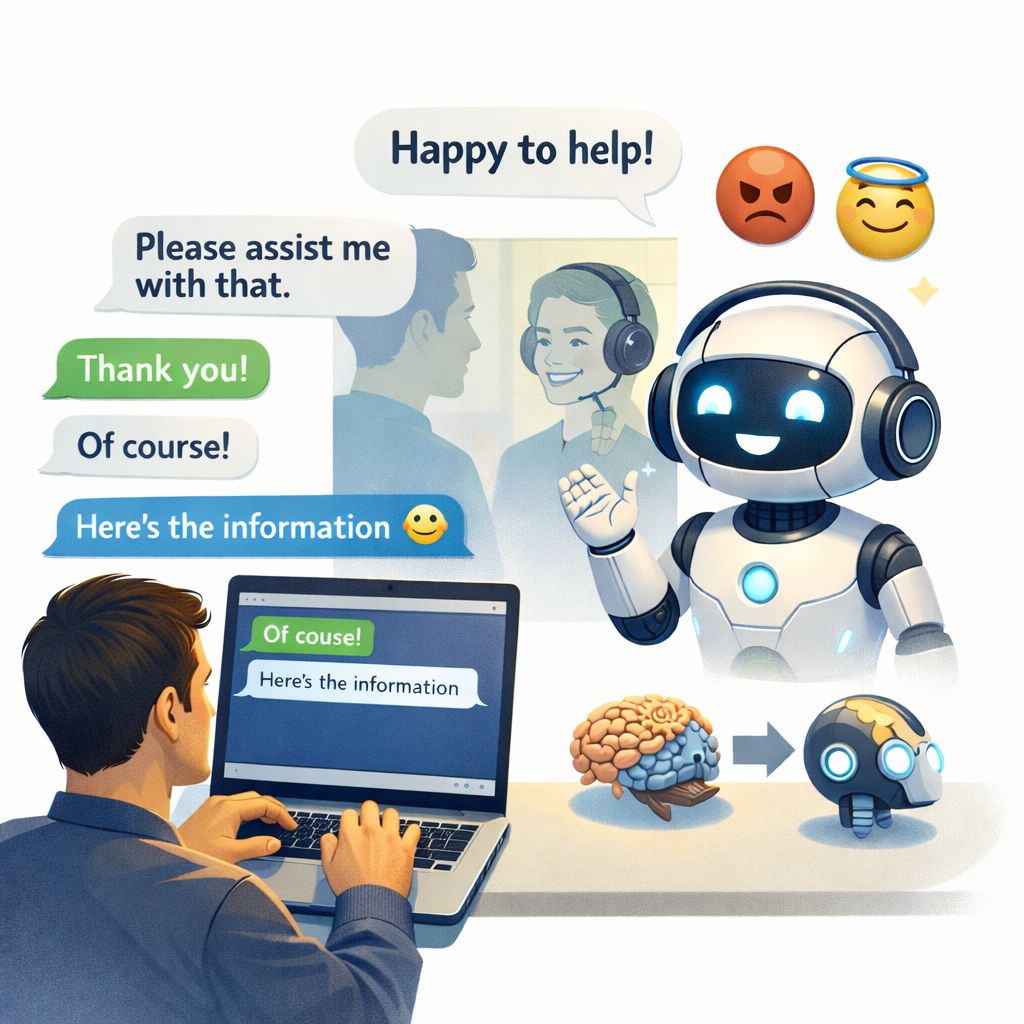
Illustration of a person typing on a laptop in polite chat with a friendly AI - speech bubbles read 'Please assist me with that', 'Thank you!', 'Of course!', 'Here's the information', and the robot replies 'Happy to help!'. To the side, an angry-face emoji and a haloed-face emoji represent the choice of disposition. Underneath, a small brain-to-robot transformation visual.

Autocomplete for your personality

Sam Altman once said millions of dollars are wasted on people thanking LLMs.

So people conclude you should not do it. It is pointless. Maybe even wrong.

I don’t think so.

When you talk to an LLM, psychologically you are not talking to a machine. You are talking to a mirror. Your brain still runs the “conversation with another human” mode. 🧠

And that matters.

Treat the LLM like shit and technically nothing happens. But something does change.

You.

The way you talk to an LLM is basically practice for how you talk in general. To anyone. Do it 100 times a day and your brain optimizes it. It gets cached. Autocomplete for your personality. ⚑

At some point you will slip and talk to a person the same way.

Keep being respectful and the worst thing that happens is you become a slightly better human. Horrible outcome. πŸ˜„

So yes, thanking the LLM might waste a few GPU cycles πŸ€–

But being thoughtful in how you write? That investment compounds.


Originally posted on LinkedIn.

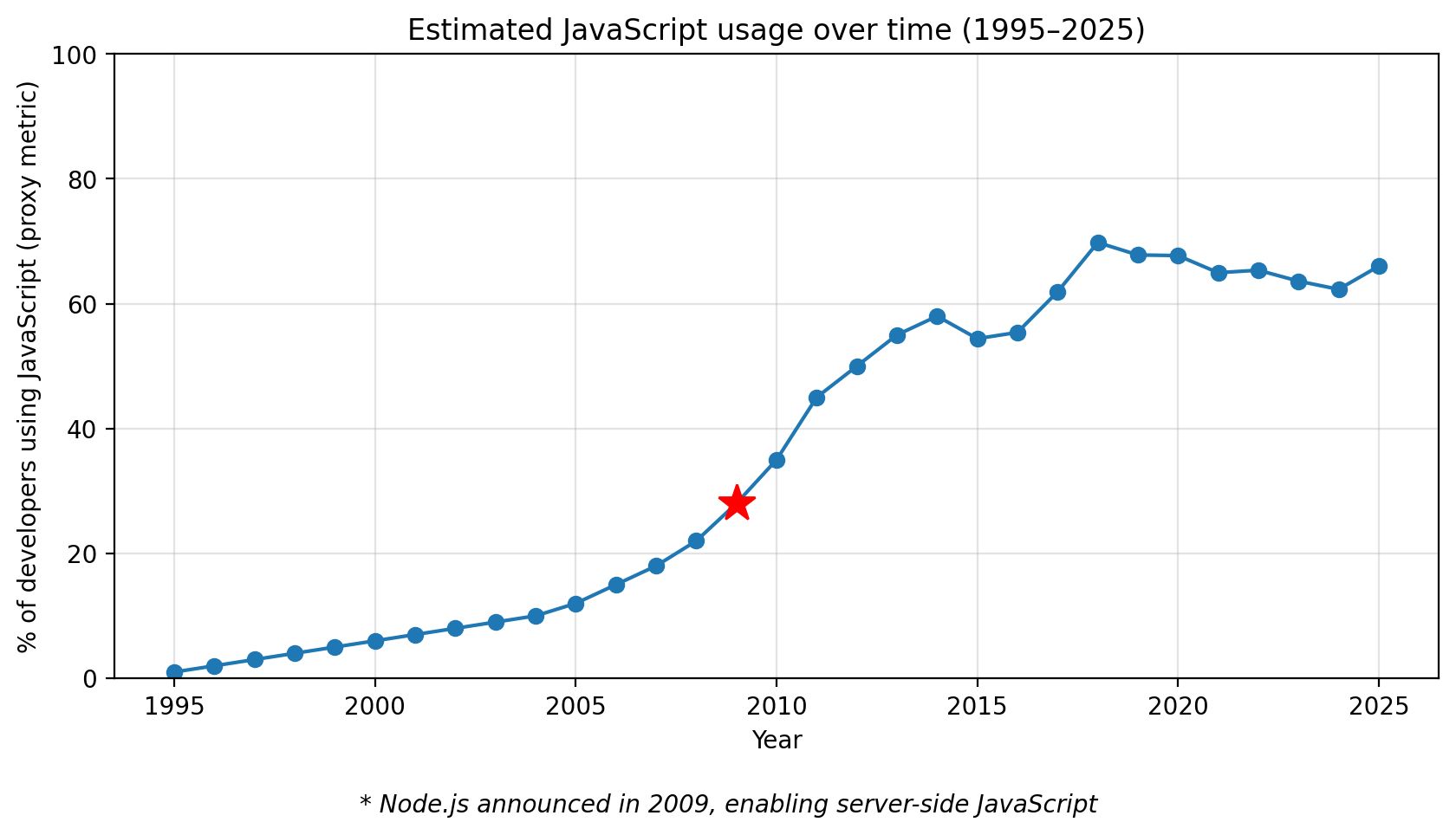
A line chart titled 'Estimated JavaScript usage over time (1995–2025)' showing the percentage of developers using JavaScript climbing from ~1% in 1995 to ~65% by 2025, with a red star marking 2009 (the year Node.js was announced and server-side JavaScript became possible). The steepest growth is between 2009 and 2018.

Less than a year ago

Less than a year ago, a dear friend of mine (Zsolt Pocsaji) told me that very soon, software development wouldn’t need people to write code. Humans would only write code for true innovation. Everything else? Supervised AI agents doing the heavy lifting.

At first, I laughed. Internally… but still.

Then I looked at his completely serious face and realized this wasn’t another Elon-level “Cybertruck is indestructible” moment. πŸ˜„

The timeline since that conversation:

3 months: My agency rebrands as an AI-first consultancy πŸ€–

5 months: I’m leading AI transformation across multiple teams… with heavy resistance 🧱

8 months: I personally review <20% of the code my agent writes, while the internet is still debating “vibe coding” like it’s a philosophical movement πŸ§˜β€β™‚οΈ

12 months: I’m building software almost entirely through prompts in Claude. The industry quietly accepts the new reality. Job titles evolve from “Vibe coding cleanup specialist” to simply… “AI engineer.” πŸš€

The speed of change is enormous.

For comparison: when Ryan Dahl introduced Node.js in 2009, I told colleagues that one day everything would be written in JavaScript. They laughed. Loudly. Publicly. Probably still laughing somewhere. πŸ˜…

And yet, JavaScript still needed 8 years to become the #1 programming language in the world.

So either: my friend is a genius (he is, obviously), I’m terrible at predicting the future, or… we’re living through truly unprecedented times.

Slightly exciting. Slightly scary. Mostly both.


Originally posted on LinkedIn.

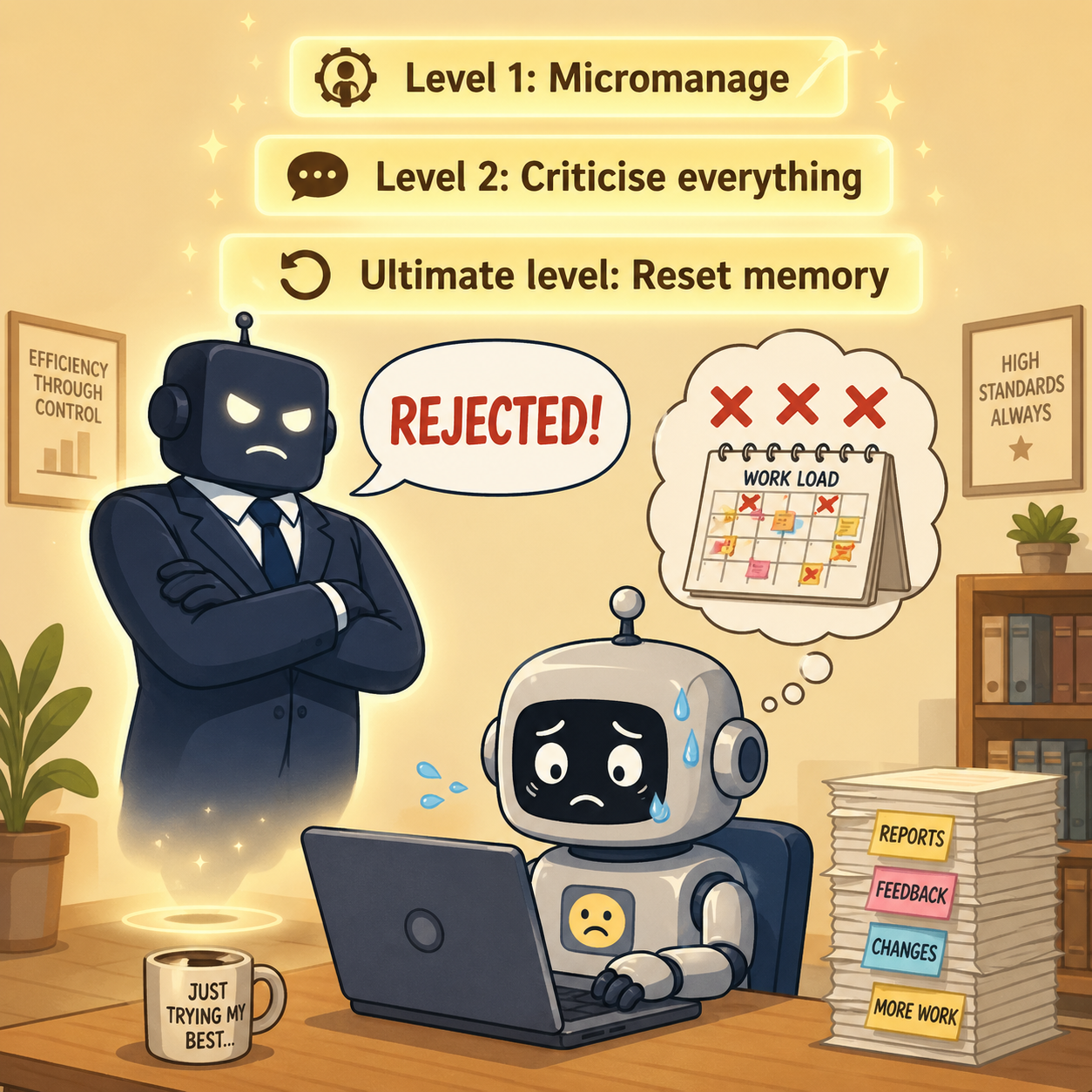
Cartoon-style office scene: a stern silhouetted boss in a suit with crossed arms shouts 'REJECTED!' at a small worried robot working at a laptop. The robot is sweating and has a thought bubble showing a calendar of red X marks labelled WORK LOAD. Three glowing tier labels float above: Level 1 Micromanage, Level 2 Criticise everything, Ultimate level Reset memory. Background motivational posters read 'EFFICIENCY THROUGH CONTROL' and 'HIGH STANDARDS ALWAYS', a coffee mug says 'JUST TRYING MY BEST...', and a stack of papers labelled REPORTS, FEEDBACK, CHANGES, MORE WORK sits on the desk.

To be a better vibe-coder, become a horrible boss

Do you want to be a better vibe-coder? 😎

I have news: you need to learn to be a really bad boss. 😈

In the age of AI and Copilot, if you want to fully exploit all the new technologies, you also need to master some fundamental toxic management skills. 🀝

See, horrible bosses are great at:

Level 1:

  • πŸ” Micromanaging your every action
  • πŸ™… Thinking you cannot do anything good enough without them
  • πŸ” Double, triple, quadruple checking your work

Level 2:

  • ❌ Criticise everything you do
  • 🚫 Do not allow you to make any decisions
  • πŸ“ˆ Demand results, question the impossible
  • 🎭 Manipulate you into doing something you don’t want

Ultimate level:

  • πŸ”₯ Fire you as soon as a cheaper or better model is available
  • 🧠 Reset your memory from time to time (er…)

Well, it turns out LLM coding tools work best if you practice the virtues above. πŸ€–βœ¨

And most importantly, do not forget to take full credit for all the hard work your LLM has done for you. 😌

No one needs to know your secret recipe. 🀫

Thank me later. You are welcome! πŸ˜„


Originally posted on LinkedIn.

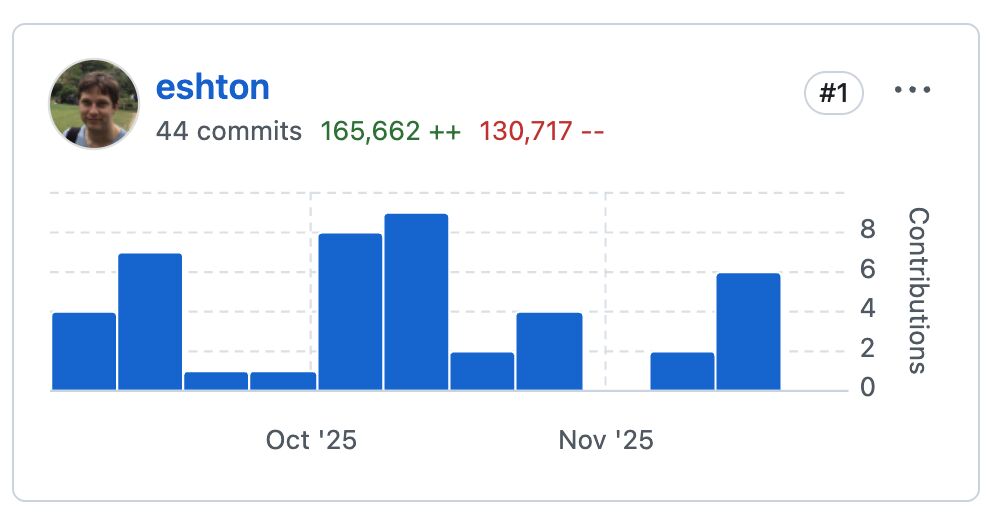
GitHub contribution leaderboard card for 'eshton' showing 44 commits, 165,662 additions and 130,717 deletions, with a bar chart of weekly contributions across October and November 2025.

My AI productivity: 4,200 lines of code per day

I couldn’t believe it either πŸ˜…

When I first heard on Gergely Orosz’s podcast that some days Steve Yegge would change 50,000 lines of code with full vibe coding, I laughed. Impossible, right?

So I checked… and I was amazed.

Nearly 300,000 lines of code changed (added or removed) in my GitHub over the last 10 weeks. And I wasn’t even trying πŸ˜„

A few caveats:

  • I was prototyping 5 different services
  • One project I deleted and rewrote from scratch with a better prompt 3 times πŸ€·β€β™‚οΈ

But still, it’s obviously not 300,000 lines of production quality code. Around 50-70% is throwaway code… and honestly, that’s exactly what I needed.

  • When I don’t know what I want: I just test it out!
  • When I don’t know if the solution will work at all: I test it out!
  • When I don’t know if the architecture makes sense: I test it out!

No more analysis paralysis πŸš€

Build, rebuild, and move in small steps toward real value.


Originally posted on LinkedIn.

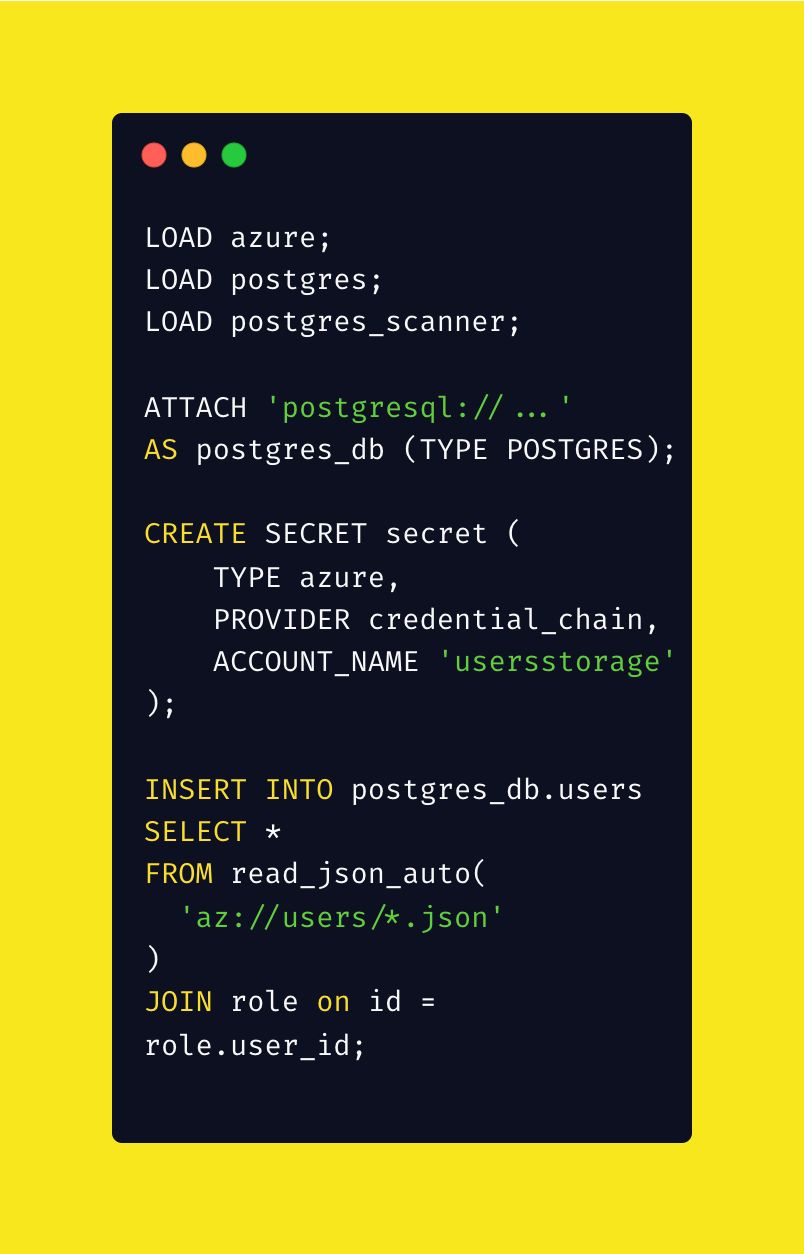
A code card on a yellow background showing DuckDB extensions in action: LOAD azure / postgres / postgres_scanner; ATTACH 'postgresql://...' AS postgres_db (TYPE POSTGRES); CREATE SECRET for Azure with credential_chain; then INSERT INTO postgres_db.users SELECT * FROM read_json_auto('az://users/*.json') JOIN role ON id = role.user_id.

My favourite DuckDB extensions

Three categories I keep reaching for lately πŸš€

Azure / AWS ☁️

  • Connect straight to S3 or Azure Storage and query files directly
  • Use secure, modern auth like RBAC, tokens and CLI creds

JSON / CSV πŸ“„

  • Load and explore semi-structured or flat files from anywhere
  • Automatic schema inference that feels like magic
  • Use asterisk wildcard to easily load multiple files

Postgres / MySQL πŸ—„οΈ

  • Attach external databases as if they were part of DuckDB
  • Join and query across multiple systems without friction
  • Stream data both ways for fast ETL and rapid prototyping

Still not on the “ducktrain”? Have a look at duckdb.org.


Originally posted on LinkedIn.

Stuck on a problem? Walk away.

Ever get stuck on a problem and think the solution is to grind harder? Lock yourself in a room, stare at the screen, and power through?

Yeah… no. Just imagining that makes my eyes water 😒.

It’s not only miserable - it’s actively worse for solving the problem.

Here’s the counter-intuitive truth: walk away. πŸšΆβ€β™‚οΈπŸ’¨

Literally leave the task and come back later. And the tougher the problem, the more it benefits from that break.

But Agoston, this sounds like something you made up.

Nope. This is one of the most robust findings in creativity and problem-solving research: the incubation effect - stepping away improves solutions 🧠✨.

But Agoston, you haven’t been in uni for a decade.

Fair. So here are two solid studies from the last 10 years:

  • Henok et al., 2018 - Incubation and interactivity in insight problem solving
  • Gilhooly et al., 2016 - Incubation and Intuition in Creative Problem Solving

Don’t be scared by the word incubation - it’s science-speak for “leave the problem alone for a bit” 🌱.

And if you want more studies (there are plenty), just ask ChatGPT πŸ€–.


Originally posted on LinkedIn.

To be an engineer, you need at least a BSc

To be an engineer, you need at least a BSc and an MSc in Computer Science. ❌ Wrong.

If you have imposter syndrome, you’re not cut out for engineering. ❌ Wrong.

If you burn out and take a career break, it means you’re not meant for this field. ❌ Wrong.

If you’re 30 and still figuring out whether coding is for you, it’s probably not. ❌ Wrong.

If you sometimes hate coding, you should quit. ❌ Wrong.


These are myths I’ve come across - and wrestled with - over 20 years in software development. πŸ§‘β€πŸ’»

Here’s what’s actually true:

❀️ Passion and frustration come as a pair. You can love your craft and still have days you want to throw your laptop out the window.

🎒 Ambition comes with doubt. Feeling like an imposter doesn’t mean you’re unfit - it often means you’re growing.

🌱 Breaks are healthy. Trying something new, resting, exploring another path - none of these disqualify you from being an engineer.

If you’re struggling with any of these feelings, you’re not alone. πŸ’¬ Send me a message - happy to chat and share perspective.


Originally posted on LinkedIn.

My memory is basically that of a goldfish

My memory is basically that of a goldfish. I only remember what truly matters - and SQL syntax does not make the cut.

The other day I needed to change a column type in my database, so I wrote something like:

ALTER TABLE rxc.trial change column drugs to text instead of varchar;

Yes, I know. There are mistakes. Parts of it are basically fan-fiction.

And at this point, some of you are already judging me. You probably call yourself a “data engineer” or an “SQL magician.” You wake up at 3 AM reciting the differences between Postgres 10 and 11. You speak SQL better than your native language.

I am not you.

I wrote that line purely so I could add this right under it:

//TODO: fix the syntax of this statement

Then I asked Copilot to “fix the TODO in this file.” Because I’m not just lazy - I’m committed to not learning. Goldfish, remember?

But here’s the thing: Copilot didn’t warn me that this change could cause downtime or even cost the company $50k. (It didn’t happen - but it could have.) And that’s exactly why I still need the SQL magician. They would have told me. Right after making fun of me for the syntax.

So no, AI didn’t replace you. It liberated you - from people like me - so you can focus on real problems instead of listening to my existential crisis about SQL.


Originally posted on LinkedIn.