Less than a year ago, a dear friend of mine (Zsolt Pocsaji) told me that very soon, software development wouldn’t need people to write code. Humans would only write code for true innovation. Everything else? Supervised AI agents doing the heavy lifting.
At first, I laughed. Internally… but still.
Then I looked at his completely serious face and realized this wasn’t another Elon-level “Cybertruck is indestructible” moment. 😄
The timeline since that conversation:
3 months: My agency rebrands as an AI-first consultancy 🤖
5 months: I’m leading AI transformation across multiple teams… with heavy resistance 🧱
8 months: I personally review <20% of the code my agent writes, while the internet is still debating “vibe coding” like it’s a philosophical movement 🧘♂️
12 months: I’m building software almost entirely through prompts in Claude. The industry quietly accepts the new reality. Job titles evolve from “Vibe coding cleanup specialist” to simply… “AI engineer.” 🚀
The speed of change is enormous.
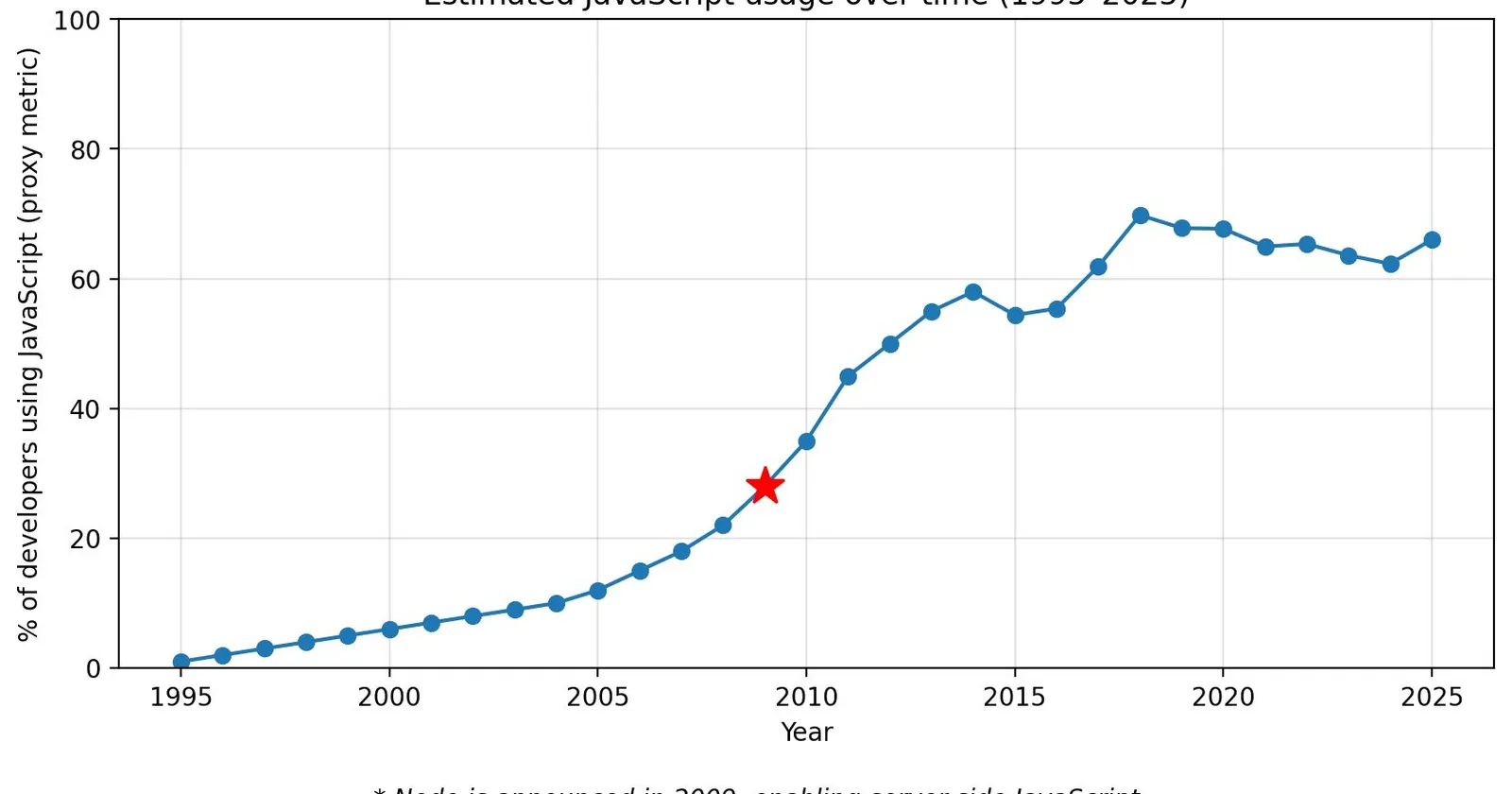
For comparison: when Ryan Dahl introduced Node.js in 2009, I told colleagues that one day everything would be written in JavaScript. They laughed. Loudly. Publicly. Probably still laughing somewhere. 😅
And yet, JavaScript still needed 8 years to become the #1 programming language in the world.
So either: my friend is a genius (he is, obviously), I’m terrible at predicting the future, or… we’re living through truly unprecedented times.
Slightly exciting. Slightly scary. Mostly both.
Originally posted on LinkedIn.